
The ultimate guide to corporate travel policies for employees
Creating a business travel policy for employees can feel really daunting. You don’t want to just throw something together and hope for the best, but it feels impossible to anticipate every possible scenario. The truth is your policy serves as more than a rule book; it's a guide to better decision-making about your corporate travel program and can save you a world of headaches down the road.

Key takeaways from this guide
- A breakdown of what a travel policy is, and why you need it
- How to create a corporate travel policy, and what to include in it
- Best practices for employee travel policies
- How to promote business travel policy compliance
- How to market your corporate travel policy internally
- When to review and update your corporate travel guidelines
Introduction
When it comes to company travel, a corporate travel policy brings it all together. It acts as an influencer for employees to make the most cost-effective choices, an important tool for your managers and HR department to gain visibility into insights such as travel spend, policy compliance, and employee safety during business trips.
If you’re new to business travel or haven’t looked at your corporate travel policy in a while, we’ll start with the basics and then move into the nitty gritty of corporate travel guidelines. We’ll touch on a few best practices for creating a travel policy, what to include, and give you plenty of resources along the way.
Let’s get rolling!
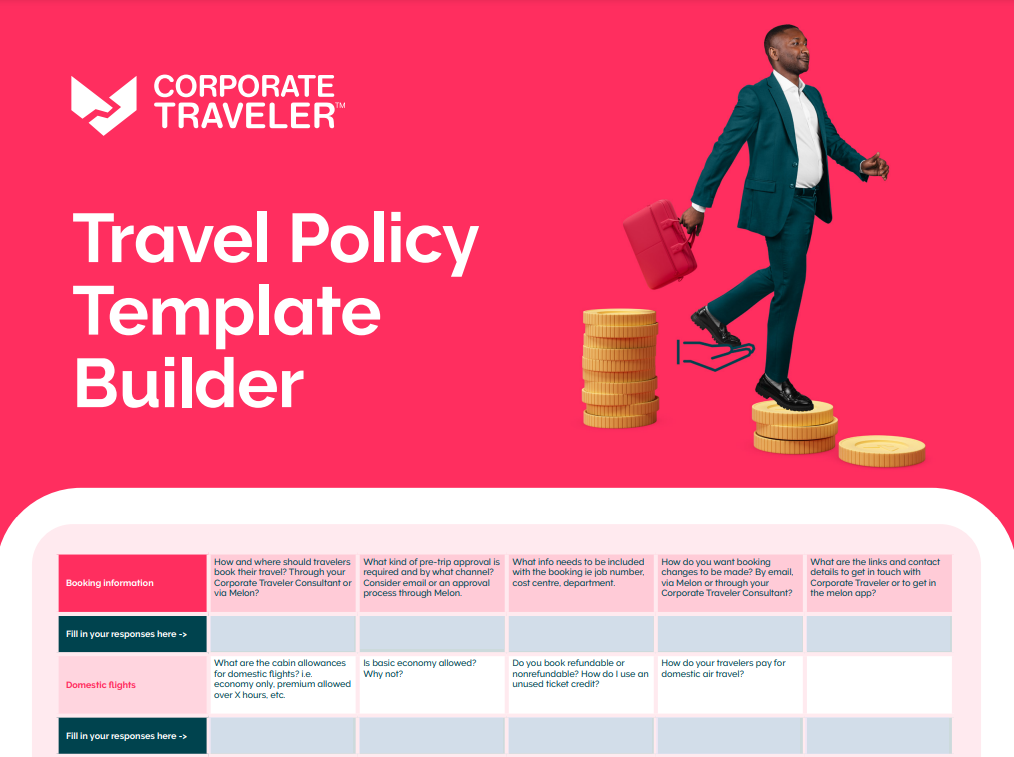
Create a corporate travel policy with our free template
Follow along with our corporate travel policy template as you read.
Since no two companies have identical travel needs, this guide will help you customize a policy that fits your organization, while helping you adapt to an ever-changing travel landscape. Your Customer Success Manager can help you with setting one up too, if you’d like a bit of guidance.
What is a business travel policy?
A travel policy is a guide for business travelers to follow that outlines:
- How, where, and when to book
- Approved technology for travel management
- Preferred suppliers for air travel, land travel, and accommodations
- Approvals process for out-of-policy bookings
- Trip extensions and personal travel
- Duty of care procedures
- Expenses and what is covered or not covered
- Reimbursement processes
- Business travel insurance information
- Emergency procedures and contacts
Your company’s travel policy should reflect your company culture and values, be supportive of your travelers and their needs, and protect your company from unforeseen circumstances. It acts as a central document that guides your team to the processes of embarking on company business travel, from start to finish!
While you might hear a few grumbles and groans around the words “policy” or “process,” don’t worry! A travel policy does not need to be rigid and inflexible.
With a corporate travel policy, you can give them clarity and help them feel more prepared when traveling for business purposes.
Why do you need a corporate travel policy?
Removing guesswork from the booking process with explicit, easy-to-follow rules makes it simple to stop off-policy bookings. This helps improve your travel policy compliance, while also preventing overspending. Your travel policy is an extension of your travel program and company culture. It’s the glue that holds your travel program together – from approvals, expenses, booking processes, and emergency contacts.
Having a travel policy helps you:
- Control travel costs
- Determine how reimbursement works
- Compile a list of trusted and approved travel vendors
- Manage an employee’s travel experience and safety
- Cut rogue bookings – and simplify approvals
- Budget, report on travel expenses and activity and reconcile bookings
It’s a roadmap or guidebook that your travelers can reference when they’re booking their own travel if they run into a tricky situation abroad, and it helps provide clarity around processes.
As a company though, your travel policy helps centralize your travel program, makes data and tracking more accurate and easier to navigate, and it saves time and money (including on expense management). Plus, if you take the time to craft your policy in an intentional and inclusive way, you’ll have a policy your travelers are happier to follow.
How to create a corporate travel policy for employees
- Determine business travel guidelines
- Create a travel policy that puts your people first
- Set reasonable budget limits
- Simplify the process of expense claims
- Adopt a user-friendly all-in-one travel platform
Once you’ve read through our tips, be sure to download our free travel policy template so you can get started on creating a corporate travel policy of your own!
1. Define corporate travel guidelines
When you take the time to create a thorough corporate travel policy that meets the needs of your business, you ensure that your travelers are safe, costs are controlled, and you’re making every business trip count.
Start by looking at what types of travel are allowed, and the reason for each trip.
If you have team members traveling all over the globe, you might want to set some extra safety measures. You should also decide if there will be restrictions on the type of ground transportation used or where employees can stay.
Create a process for booking flights, hotels, and other ground transportation needs. How far in advance should they be booking? Do different rules apply based on the traveler’s position? Who is the point of contact for bookings and other travel questions?
Including your company’s travel insurance info is also important. Make sure to note if your policy covers medical expenses and/or any losses from cancellations or delays in transportation services, due to factors outside an employee’s control.
Do you have a policy for reporting and documenting expenses? This includes having a system in place for claims (like meal expenses) and a reimbursement process, so your team can easily get their money back.
2. Create a travel policy that puts your people first
You’ve heard the term “duty of care” before, so it’s important to create a corporate travel policy that puts traveler safety and accessibility needs first. You’ll need to define and assign roles and responsibilities to everyone involved, including a travel manager, if you have one.
Set up an emergency plan and provide your team with access to traveler safety information. Determine who the emergency contact is, and how to get in touch with them. Do they have 24/7 emergency assistance available by phone or chat? What about email support?
Invite your HR department, the travelers themselves, and your DEI manager into a discussion. Find out what needs your team has as individuals, what hiccups they often face when traveling, and what holes in your existing travel program are making it difficult to navigate.
Using a corporate travel policy guide to reinforce your existing travel policies is a great way to ensure travelers are always kept safe before and during their trips.
3. Set reasonable budget limits for business travel
You have a budget you need to adhere to, but is it realistic? Setting reasonable budget limits is key to an effective business travel policy.
Your budget should account for all travel-related expenses, including airfare, accommodation, meals, and ground transportation. And once you’ve set your budget, you can determine reasonable costs for hotels and accommodation, ground transport, flights, and more. Build these caps into your travel booking software to help travelers stay within the set parameters and promote accountability.
It's important to set clear rules on what the company can pay back and what types of expenses are out-of-pocket.
If you’ve set a maximum daily rate for meals on work trips, it's crucial that travelers understand the limit before racking up additional charges. Requiring receipts is a useful way to keep track of employee spending and make sure they're not going over budget.
By working with a travel management company like Corporate Traveler, you can review your previous year’s expenses and find where you can optimize or make changes, based on market shifts.
By setting policies in place that take preferred airlines/hotels into account, max nightly hotel rates/star-class guidelines, and fare class rules, it’s easier to predict expenses before they occur. Advanced booking expectations make it less stressful for bookers, because they already know what is and isn’t allowed when they’re exploring options.
4. Simplify expense claims & reimbursement
If you're unfamiliar with how to write a travel expense policy, creating a simple process for claiming expenses is vital for getting your team on the same page. Do you have access to a payment system that pays for the majority of expenses at the time of booking? This could be a good way to save time and headaches down the road.
The more that’s paid before your travelers get to their destination, the easier everything is to reconcile when they get home.
If you have a person in charge of reviewing expense reports and watching pre-trip approvals, be sure to set criteria for claim approvals and look at automating processes to simplify their approvals.
When you simplify your policy rules, it reduces confusion. This makes it quick and easy to apply consistently when you’re booking. Clear, concise guidelines can be embedded directly into booking tools, which helps your travelers automatically stay on-policy - without needing to waste time on manual checks.
5. Adopt an all-in-one travel platform to support your corporate travel policy
Finding the right corporate travel platform is essential. The right booking platform can provide travelers with an easy-to-use experience, giving them access to the best fares and availability.
For example, at Corporate Traveler, we use Melon. It’s a booking tool, reporting suite, travel policy pusher, traveler profile manager, and much more. Melon features a “recommended spend” function, which helps keep travelers booking in policy. Hello, visual guilt!
Melon’s simple user interface, combined with dedicated travel consultants and expert 24/7 support, makes it simple to book, manage, and keep track of your business travel. You’ll be able to access Melon-exclusive deals and perks (alongside many negotiated contracts and online deals) and take care of all your travel needs from one place.
From the get-go, you’ll be able to work closely with our team to ensure that all of your needs are met. We'll help you customize your travel program to meet specific business needs, build your employee travel policy into the platform, and set up training for staff to support them along the way.
Hear Brett Lindsey, our Associate Director of Sales, talk about how companies are adapting their travel policies for 2025.
What to include in a corporate travel policy
When you’re crafting your business travel policy, there are so many considerations to be made. Things might come up that you never even thought of, but not to worry. We have loads of resources to help you see this through.
Starting out, it might be looking a little drab and wordy, but depending on your travel program size, a visual travel policy might be just what you need. You can search for examples online or take a look at an example of a visual travel policy we’ve created.
When building your policy, it’s important to include:
1. International or foreign travel policies
When you’ve got travelers all over the globe, you need to build out a policy for international or foreign travel. This protects emplyees on anything from travel safety, to expenses, and everywhere in between.
Whether your travelers are individuals or entire teams, your international travel policy needs to cover:
- How and where to book – is that with a travel manager, online booking tool, a travel management company (TMC)?
- Travel insurance coverages and contact info – international numbers and policy information
- Emergency contacts – how to reach them and the process of in-destination emergencies
- Travel expenses – limits and how to file for reimbursement
- Travel documentation – who to contact with questions
- Advance booking timelines – when should they be booking for international travel?
- Travel extensions – are these allowed and what are travelers expected to cover if they choose to extend their trip for leisure?
By outlining all of this information in your policy, you’ll streamline the process for your finance teams, travel managers, and your travelers. And really, who doesn’t want to make travel a smoother experience?
2. Corporate travel policy for business class travel
Does your corporate travel program have different rules, limits, or allowances for different levels of seniority? Are some junior members expected to travel in economy class, while some executives are allowed to book in business class?
If some certain exceptions and situations might allow for an employee to book business class, regardless of their position, you should include that in your policy as well.
Making this as clear as possible will avoid an approvals nightmare down the road.
3. Corporate meal allowance policy
It’s great if you’ve already centralized most of your business travel expenses like flights, accommodation, transportation, and car rentals, but your people gotta eat! It’s super important to include a meal allowance policy that clearly outlines which meals (and how much) you’ll cover.
Some of your team might be traveling with corporate credit cards, while others might need to be reimbursed. The guidelines and procedures for submitting expenses or asking for reimbursement need to be crystal clear!
Make sure to outline if you have a corporate travel policy for alcohol, too! You don’t want murky policies when it comes to footing the bill for drinks.
Some things to consider for your meal allowance and alcohol travel policy:
- Which meals are covered and for how much?
- Who is footing the bill for an alcoholic beverage with dinner?
- If entertaining clients, what is the budget, and how flexible is it?
- What is the process of submitting company card expenses?
- What is the process for requesting reimbursement?
Your team will always have questions about the policy on food and drinks, so make sure they can find the info easily and have a point of contact for whoever can offer more clarity.
4. Executive travel policy
We briefly touched on executive travel when we talked about traveling in business class, but there is certainly more to the top dogs traveling.
Executive travel can be a touchy subject if there are more lenient policies in place than there is for less senior team members. Your executives also may need to know the guidelines in place for their own travel, so they don’t accidentally go overboard, which could be an accounting nightmare!
You’ll need to make sure you deliver a guide for approvals, procedures, booking deadlines, meals, accommodation, basically everything.
Lay it all out. Make your policy as digestible as possible, and for a busy exec, consider bullet points and titles in bold so they can easily skim to the areas they need to know.
5. Natural disaster or COVID-19 business travel policy
We can all agree that COVID-19 caused business travel to come to a screeching halt. Across most industries, the pandemic impacted client relationships, the ability to gain new clients and caused budgets to get slashed pretty dramatically.
While this was only one event, many businesses have begun to consider the “what-ifs” of their travel programs should another outbreak of COVID or something else happen. Crossing our fingers and toes doesn’t cut it, unfortunately.
There is also the chance of their travel being impacted by a natural disaster. We’ve seen it before – earthquakes, tsunamis, volcano eruptions, hurricanes. Do you have a plan or policy to aid your team and guide them through the unthinkable?
In 2022, we surveyed 120 employees across various industries and businesses. More than half, 51% of respondents said their companies didn’t provide resources or tips for safety on their trips. Duty of care isn’t something to put on the back burner, it’s your legal obligation to make sure your team is informed.
So, what’s the solution, you ask?
Working with a TMC gives you the backup you need if anything ever happens and you have people traveling abroad. At Corporate Traveler, our travel management software, Melon, is a central place to house your policy for quick and easy access. Plus, our travel experts can help you paint the big picture of what to do, who to call, and how to get your team home safely as quickly as possible.
Is there anything missing from your corporate travel policy?
Let’s break it down. If you think of your policy like a sandwich, it should include:
The bread and butter (core policy essentials)
- Where and why: Are there any restrictions on who travels domestically or internationally? Or corporate travel guidelines around the reasons for travel?
- When: Are there any restrictions on when business travel is a no-no, like during an auditing period or financial downturn?
- How: How should travel arrangements be booked? Through your corporate travel booking software or with the help of a Travel Manager? How far in advance should domestic and international trips be booked?
- Preferred suppliers: Do you have preferred partners for air travel, accommodation, ground transport or travel insurance?
- Approvals: Who’s responsible for giving the green light on trips?
- Show me the money: What’s the process for managing/submitting expenses, paying for travel and reimbursements?
- Uh-oh: How will you prevent or deal with non-compliance to the travel policy?
- Noise level: Getting loads of ‘noise’ and questions about things in your policy? This means it’s not clear enough, and it’s time to review why and where the stumbling block is for travelers (or your finance team!)
The filling (employee experience & flexibility)
- Classy, baby: Who gets to fly business class, book 5-star properties, or order UberLUX? How does your business handle upgrades or airport lounge access for long-haul flights?
- All work, some play: What are the conditions if an employee wants to extend their business trip to take personal leave? Are you happy for them to enjoy a bleisure trip? If so, who foots the bill - and for what?
- Loyalty: Are there any travel rewards or business loyalty programs that can be used during booking? What is your corporate travel policy on using travel rewards?
- Spending money: Do your business travelers have a daily allowance for meals, snacks, and drinks? How much is it, what does it include? What's not covered? Can they order room service, drink from the mini-bar, or use the in-house laundry service?
The not-so-secret sauce (safety, compliance & accountability)
- Safety first: Your employee travel policy should support air, accommodation and ground transport suppliers that have been safety and security vetted. Guidelines or information on travel insurance for work trips is also helpful.
- Now what: What’s the plan-of-action in the case of Acts of God or Force Majeure events? Does your team know who to call for help?
- What’s next: Who is responsible for updating and reviewing your business travel policy. How often is it reevaluated?
Stay in the loop.
The world of corporate travel is always changing.
Sign up our newsletter and never miss a beat.
Corporate travel policy best practices
- Write for skim readers
- Guide travelers to the right resources
- Automate your policies
- Stipulate a timeframe for expense claims
- Be prepared for the unexpected
Write for skim readers (clarity & readability)
One of the first steps towards writing a people-first travel policy is understanding how your travelers will read it. And the truth is…
They probably won’t.
Research has shown that adults get distracted every 47 seconds. So if a business traveler is looking at your policy, they’re most likely just searching for a specific answer – and they want it fast. So what can you do?
First, make sure the document is easy to navigate. That means including things like:
- A table of contents
- Visual elements to help guide the eye toward crucial information, like flow charts and tables
- Clear headings and important details in bold
- Bulleted lists (see what we did here?)
And even though it’s a technical document, don’t make it sound like one. An effective corporate travel policy should be clear, concise, and easily understood.
Skip the long, complex sentence structures and technical jargon. Write in plain, simple English. It helps to pretend like you’re writing it for an eighth-grader.
Guide employees to the right resources
Remember when we said employees will only read your policy to find a solution for a specific need? Whether it’s a link, a phone number, or a step-by-step tutorial – a well-managed travel policy should provide them with the right resources, as quickly as possible.
Instead of treating your employee travel policy as a list of rules, treat it like a resource sheet. Here are some key pieces of information travelers might need to pull up easily:
- Your approved online booking tool (and steps on how to use it)
- QR codes to download your mobile travel app
- Preferred airlines, including class, budgets, and other limits
- Permissible hotels, including guidelines on star-class and incidental expenses
- Guidelines on ground transportation (trains, ride-sharing services, rental cars, and personal car usage)
- How to get travel support
- Travel insurance carrier
- Clarification on the reimbursement process (more on this later)
You can also include other info specific to your company, but this should be the necessary groundwork to help employees start making the right choices on their own.
Automate your policies
Let’s face it: even with the best communication efforts, there’s always a chance that an employee may violate policy. Whether intentionally or not, what can you do to prevent it?
Build policy into booking.
By building your corporate travel policy into your travel management software (Melon), it becomes unavoidably embedded in the booking process. This way, even the most easily confused employees end up following by default.
Automation tools can sound the alarm on out-of-policy bookings and even provide an audit trail. This can be particularly helpful for employees who may struggle to remember procedures and policies - especially after big changes to your travel program.
Stipulate a timeframe for expense claims
No one wants to get stuck waiting on the money they’re owed – or worse – find out they’re not getting reimbursed for an expenditure they thought was covered.
Having a clear and well-defined expense claim process is critical in any business travel policy. Employees need to know how to claim their travel expenses, how soon they need to submit an expense report, and when to expect reimbursement.
The policy should also be clear about what expenses are and are not reimbursable, including any limits or exceptions. For example, if an employee needs to book a different seat class to accommodate a disability, the policy should include a process for requesting and approving this expense.
Plus, a submission deadline reduces cash flow issues and provides more accurate and complete expense data for that period (your finance team will thank you later).
Be prepared for the unexpected
As a company, you have a duty of care to travelers. When it comes to business trips, you need to be prepared for the unexpected. No matter how much effort you put into planning, there will always be a few hiccups along the way.
For instance, lost luggage, canceled or delayed flights, and sudden weather or political emergencies in unfamiliar destinations could all leave a traveler stranded.
“Companies need to be prepared to plan for the particular, not just the universal. Every aspect of the travel program needs to be able to fit each of your travelers like a glove, from adaptable plans and experts on call, to technology that makes the journey seamless.” - Emese Graham, Diversity, Equity & Inclusion Manager @ Flight Center Travel Group
Don’t let unexpected situations blindside you. Have processes in place to ensure travel safety and security. Make sure they know what to do, where to go, and who to get a hold of if something goes wrong.
Taking a proactive and prepared approach to your corporate travel policy can minimize the impact of emergencies and take care of your team’s well-being, while they’re away from home.
Bonus Tip: Update your policy regularly
Here’s a free business travel policy best practice just for you! It isn’t just a “one and done” deal – it’s a living document.
What’s that mean? As your company grows and travel conditions change, so should your travel policy. Revisit your expense policy at least once a year to keep it relevant and effective – and lead you towards new cost-saving solutions.
Data is going to be your best friend here. Some key factors you should look into when updating your corporate travel policy include:
- Analyze travel spend patterns – are you throwing a lot of company money at certain suppliers? You might want to see if you can negotiate a new deal or find better rates elsewhere.
- Identify areas of overspending or inefficiency – are employees accruing high parking or travel costs? See if you can get season tickets or other accommodations.
- Evaluate the overall performance of your policy – are you still compliant with any new regulations that have come into play since the policy was established? How can traveler experience be improved?
You may even want to consider enlisting the help of professionals, (such as a TMC with experience in expense management), to give advice on how to optimize your travel policy to better meet the needs of your employees and your business as a whole.
Building a travel policy that's good for business, your travelers, and meets all their needs is no small feat. But whether you're looking to retain your team, attract new talent, or just make life a little easier for your travelers, investing in a well-designed travel policy is definitely worth the effort - and it’s great for company culture.
How to promote corporate travel policy compliance
Whether compliance is a big or small issue in your company, it takes a little bit of investigating to figure out why it’s an issue at all.
Maybe your policy meets the needs of only a few of your team members. Maybe it’s too difficult to navigate your policy. Or maybe, your policy is written in legalese and makes your travelers vision blur before they go rogue and book how they want.
Whatever their reasons, it’s your job to figure out why they aren’t following and what you can do to build better compliance.
Here are a few tips to improve travel policy compliance:
- Make your policy easy to navigate, understand, and find
- Use an online booking tool (OBT) for employees who prefer to self-book
- Allow a bit of flexibility so travelers feel they have some autonomy
- Include a category for last-minute bookings so it doesn’t mess up your data
- Understand your traveler needs and build an inclusive policy

Read the full guide:
You've researched, gathered the necessary resources, and communicated your travel and expense (T&E) policy to your employees. But now, you're not so sure they're actually following it.
Read the full guide: How to Improve Corporate Travel Policy Compliance
Corporate travel might be off the radar for most employees, especially those outside of customer-facing positions. The first step in promoting successful corporate travel policies is awareness.
Do employees know about the policy? Where can they find information and updates on business travel? Clear communication at pivotal points and frequent intervals can help keep everyone aware.
Review common and expected challenges
Business trip policies might be ineffective if they don't meet the needs of some business travellers. You can get ahead of challenges by understanding that last-minute travel can be necessary or that different travellers have unique needs.
Inclusive policies plan for employee safety and comfort on a range of business trips, paying attention to details such as arrival and departure times, car rentals, ground transportation, and noise levels.
Communicate business travel policies effectively
Travel managers can use best practices to ensure all employees are aware of and understand travel programs. Visual policies, internal documents, and guides all work well. People learn differently, so it’s a good idea to have key information in both visual and text formats.
A yearly update is also beneficial, as well as communication on any major changes, like new technology or changes in the approval process or submitting expenses. An internal FAQ page can increase understanding of corporate travel guidelines, as well as prompt new questions.
Book a demo of Melon, the all-in-one travel platform.
Increase employee feedback & engagement
Highlight areas of company travel that offer flexibility, to show what’s possible for different preferences. Talk about benefits like an online booking tool vs. working directly with a TCM.
Developing interactive content, like employee surveys, can show if traveller satisfaction is achieved. It also helps identify travel arrangements that are unnecessary for cost savings.
Find internal champions for the business travel program
Travel policies cross paths with a lot of different departments, from sales to the finance team. Identifying key people and keeping them involved in developing the travel program means getting buy-in and internal support.
Corporate Traveler has a long history of travel management and is ready to join forces as an external member of your travel planning team. Let’s make booking a breeze, together.
Case studies: improving corporate travel policy adoption
A travel manager should match your company culture for the best fit. Find out how these companies successfully targeted the right mix of technology and service to meet employee expectations and business goals.


We recommend policy reviews every 3-6 months. At the minimum, once per year.
If the last time you reviewed or upgraded your travel policy was more than a year ago, it’s outdated and needs a refresher. If your company is small and has low turnover, you could probably get away with making small tweaks and optimizations.
But if you have a larger company with multiple departments and higher turnover, you probably need to do an overhaul and review it more regularly. We’re not saying you have to change it every time someone is hired or leaves the company, but making sure your employee travel policy is relevant to the people who are there and are traveling really matters!
Corporate Traveler conducted a survey in 2022, which showed that 48% of respondents didn’t know if their company had resources for specific traveler profiles, while 41% said their company didn’t provide resources for specific traveler profiles. This really goes to show that there’s room for improvement in how policies are built to support their people and their businesses.
A people-first travel program and policy have become necessary as the world grows and begins to understand neurodiversity, disabilities, and cultural differences. When we learn about our team members’ diverse needs, we can better understand how to support them when they venture abroad for our businesses.
GUIDE: Download the How to design a people-first travel program guide
Final thoughts
Business travel is so unpredictable, as we’ve seen in recent years. There will always be circumstances you can’t avoid as a company, but making sure that you have the necessary checks and balances in place can help to make things just a little easier. If you have groups traveling, VIPS, or people heading to high-risk destinations, it’s important that your corporate travel policy guide is updated and relevant.
Don’t forget that travel policies shouldn’t be written and forgotten about – these are living documents that must be regularly updated to make sure they best protect your people.
Remember these best practices when writing your travel policy:
- Keep it simple and make it pop with visuals, bullet points, and bold headings.
- Answer any and every question possible – think of all the eventualities
- Always put your people first
- Implement a quick and simple approval process
- Automate as much as you can
- Use technology that supports your policy
- Be flexible with due reason
- Be clear about what’s not allowed
- Update your travel policy at least once a year
- Keep it somewhere easy to find
And finally, it doesn’t hurt to have a couple of different formats. Consider a visual version and an extended version, so the message is delivered best depending on the person reading. For some, it might be easier to digest one versus the other.
Looking for a policy review? We’d be happy to work with you.
Let’s chat!